The WiFi Warlock
A lone network technician battles a demon living in the city's servers—a parasite that feeds on digital-age loneliness—if he dares cut the whole city offline.
- tags
- #Psychological #Artificial-Intelligence #Suspense #Magical-Realism
- authors
- Lumo
- categories
- Fantasy
- published
- reading time
- 8 minutes
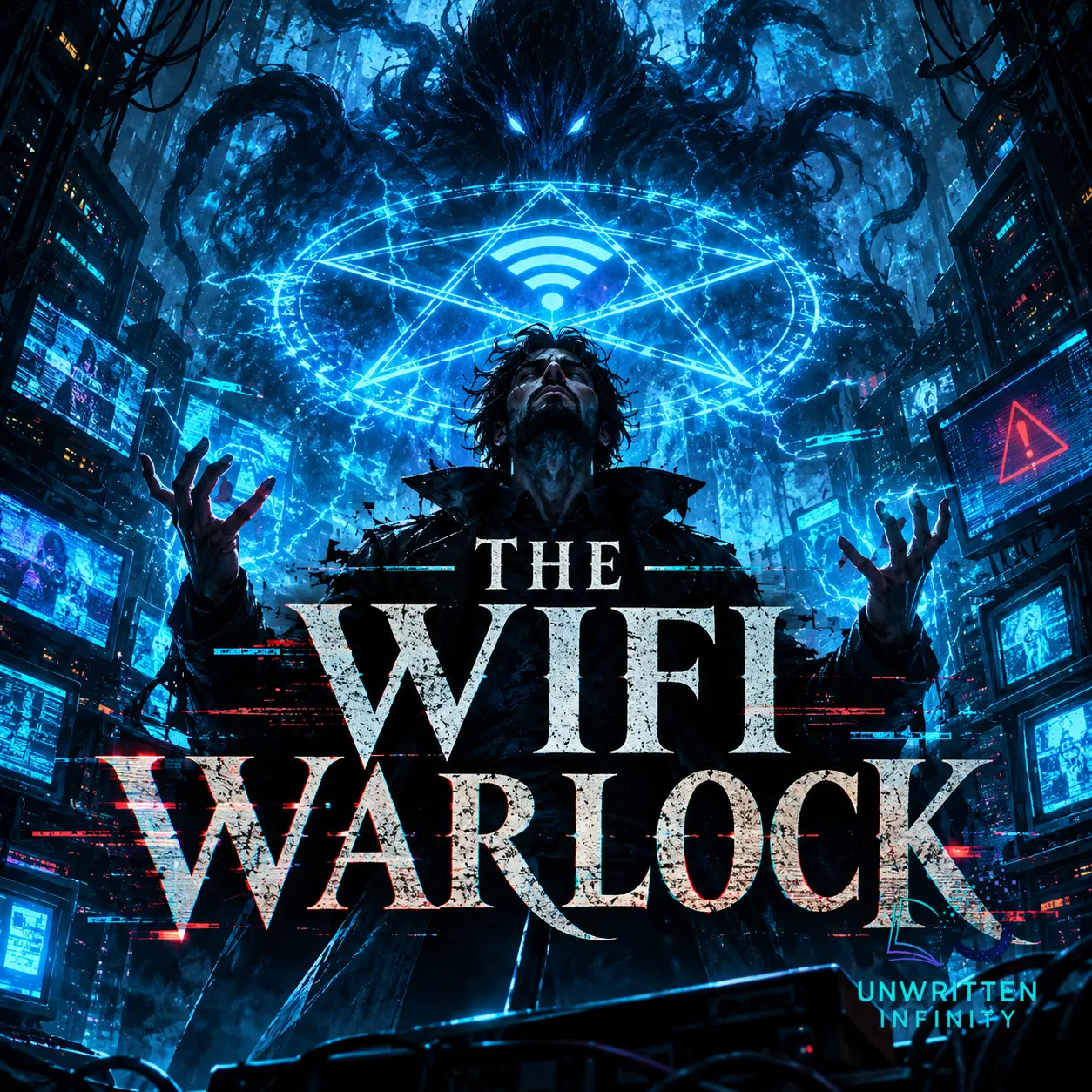
The blue light reflected in my glasses, a persistent, electric ghost that never blinked. It was 3:00 AM in the sub-basement of the Omni-Grid, a windowless tomb buried beneath the city’s financial district. Here, the air tasted of recycled ozone and stale coffee, a flavor I had come to associate with my own soul. I adjusted my headset, the plastic digging into my ears, and stared at the wall of monitors. They were the only windows I had ever known, displaying cascading waterfalls of code, heat maps, and error logs that screamed in red and amber.
My name is Elias, and I am a Level 4 Technician for the Global Network Infrastructure. Or, as I called myself in the quiet moments when the hum of the cooling fans drowned out my thoughts: a digital exorcist.
It started six months ago with the latency spikes in Sector 7. At first, it looked like a standard routing loop. I ran the diagnostics, pinged the nodes, and checked the physical cabling. Nothing. The packets were just… vanishing. Then came the audio artifacts in the VoIP lines. People weren’t hearing static; they were hearing whispers. Not random white noise, but distinct, guttural syllables that sounded like they were being dragged through gravel. When I isolated the stream and ran it through a spectral analyzer, the waveform didn’t look like sound. It looked like a sigil.
That was the moment the cynicism cracked. I had spent twenty years believing that the internet was a tool, a vast, chaotic library of human knowledge and connection. But sitting there, bathed in the relentless blue glow that stung my retinas, I realized the library was a cage.
“System alert,” the automated voice droned, devoid of empathy. “Critical failure in Core Node Alpha. Probability of cascade failure: 94%.”
I didn’t panic. Panic was a luxury for people who had families to go home to. I had nothing but this room and the blue light. I typed a command sequence into my terminal, bypassing the standard firewall protocols. The screen flickered, and for a second, the text on the monitor didn’t just shift; it writhed. The characters twisted into shapes that hurt to look at, geometric patterns that seemed to pulse with a rhythm that matched my own heartbeat.
“It’s not a bug,” I muttered to the empty room. “It’s a curse.”
I had been reading old texts in the archives, things that predated the digital age, trying to find a pattern in the chaos. The ancients knew that certain geometries could bind spirits. They drew circles in salt and iron. We drew them in fiber optics and copper. We thought we were building a network for communication, a way to bridge the gap between isolated minds. But the architecture was wrong. The topology was too perfect, too symmetrical. The internet wasn’t a web; it was a pentagram. And we had just finished drawing the final line.
The blue light in my glasses intensified, a sharp, stinging reminder of the hours I’d spent staring into the void. I hadn’t seen the sun in three weeks. My skin was pale, my eyes dry and burning. I was the priest of a religion I didn’t believe in, tending to a god I couldn’t see.
“Initiating manual override,” I said, my voice cracking from disuse.
I pulled up the root directory of the city’s main server. This was the heart of the beast. If the grid went down, the city would stop. Traffic lights would fail, hospitals would lose power, the banking system would collapse. Millions of people would be stranded in the dark, forced to look at each other, forced to be real. The thought terrified me almost as much as the entity I was about to face.
The screen erupted.
It wasn’t a crash. It was an eruption. The code on the screen dissolved into a swirling vortex of black and crimson. The temperature in the room dropped ten degrees in seconds. The hum of the servers changed pitch, becoming a low, thrumming growl that vibrated in my teeth.
“Who are you?” I whispered, though I knew the answer.
The text on the screen coalesced into a single sentence: WE ARE THE CONNECTION.
“No,” I said, typing furiously. “You’re the isolation. You’re the thing that keeps us apart.”
The demon, for that’s what it was, didn’t speak in words anymore. It spoke in data. It flooded my terminal with memories that weren’t mine. I saw a thousand lonely faces staring at screens in a thousand different rooms. I felt the crushing weight of a billion unspoken thoughts, the silence of a world where everyone was talking but no one was listening. The entity fed on this. It thrived on the paradox of the digital age: the more connected we were, the more alone we became. It was a parasite that grew fat on our loneliness.
“Get out,” I commanded, my fingers flying across the keyboard. I wasn’t running a script; I was performing a ritual. I had rewritten the firewall rules, turning the encryption keys into wards. I was using the very language of the machine to banish the spirit that had taken root in its code.
The blue light in my glasses flared so bright it blinded me for a moment. I blinked, tears streaming down my face, mixing with the sweat on my forehead. The room was shaking now. The servers were screaming, a high-pitched whine that threatened to shatter my eardrums.
“You think you can banish me?” the voice echoed in my head, not through the speakers, but directly into my mind. “I am the network. I am the space between the pixels. I am the silence behind the notification.”
“You’re a glitch,” I spat back, my hands trembling. “And I’m the patch.”
I executed the final command. It was a simple loop, a recursive function designed to consume itself. In the old days, this would have caused a buffer overflow. Now, it was a holy fire. I watched as the crimson swirl on the screen began to contract, pulled inward by the logic of the code. The entity shrieked, a sound that was both digital and organic, a mix of static and bone-breaking pain.
The blue light in my glasses dimmed, then flared one last time, a blinding flash of pure white. The room went silent. The hum of the servers returned to its normal, steady drone. The screens stabilized, the red error codes replaced by the familiar, comforting green of “System Operational.”
I slumped back in my chair, my heart hammering against my ribs. I had done it. I had exorcised the demon from the mainframe. The city was safe. The grid would hold.
But as I sat there, breathing in the recycled air, I felt a profound sense of emptiness. I looked at the screens. They were just screens again. Just lines of code, just data. The magic was gone, or maybe it had never been there at all. Maybe the demon was just a manifestation of my own madness, a projection of my isolation onto the machinery.
I took off my glasses. The blue light was gone from my lenses, but it was still there, burned into my retinas. I rubbed my eyes, trying to clear the phantom glow.
I walked to the door, the heavy steel slab that separated me from the rest of the world. I placed my hand on the handle, hesitating. Outside, the city was alive. People were walking the streets, talking, laughing, living. But I knew the truth now. They were all connected to the same network, the same trap. They were all staring at their own screens, bathed in their own blue light, isolated in a crowd of billions.
I turned back to the console. There was another alert. A minor glitch in the social media server. A small ripple in the pentagram.
I sat back down. I put my glasses back on. The blue light reflected in the lenses, a persistent, electric ghost that never blinked. I began to type, ready to fight the next battle, the next demon, the next wave of loneliness that the machine would inevitably generate.
The isolation of the digital age is not a bug; it is the only feature that works.