The Static Between Stations
A late-night DJ must keep a mysterious signal alive to protect the city, until the terrifying truth emerges: the static isn’t a cage. It’s food.
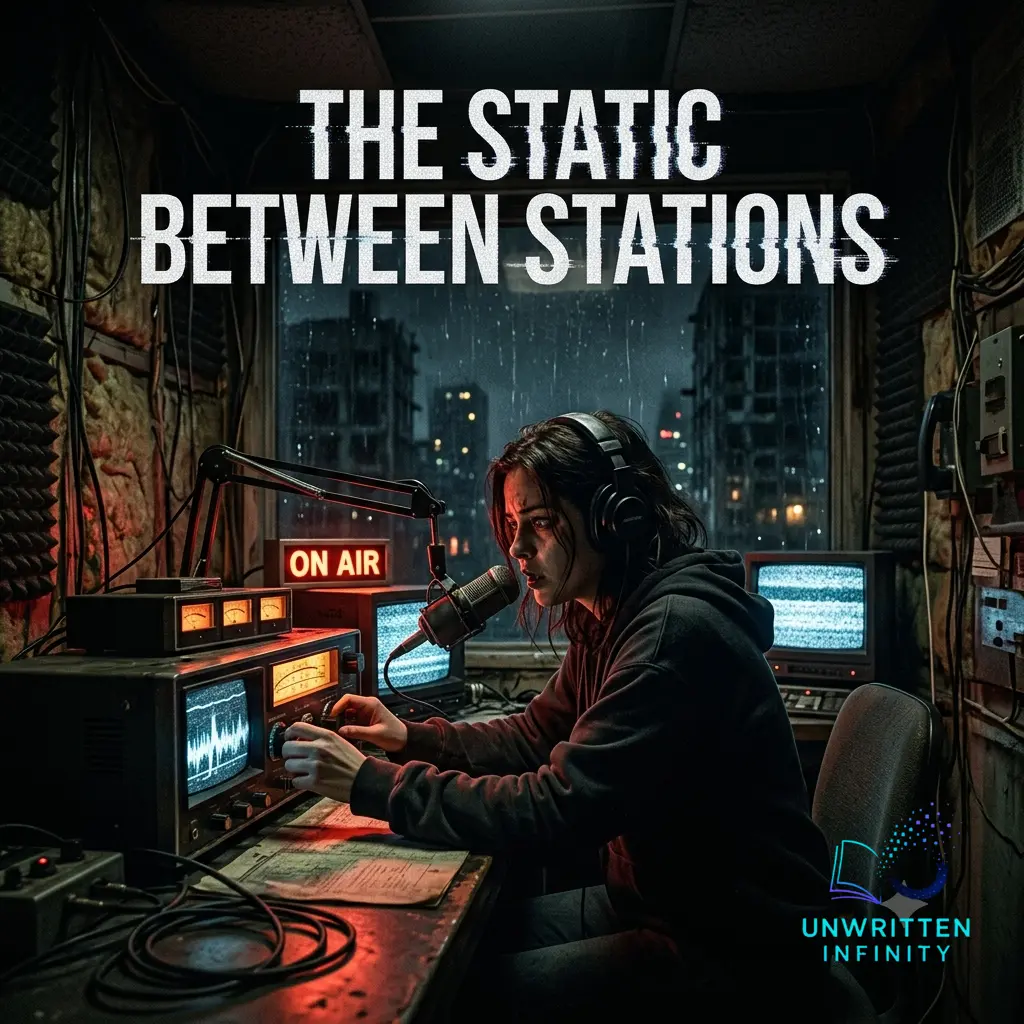
You always start by killing the lights.
It isn’t a superstition—not exactly. It’s survival. Inside the cramped booth seven floors from the top of a derelict skyscraper, the darkness presses in close, humming faintly with the building’s uneasy bones. You sit in the single leather chair whose stuffing has long since given up, position your hands above the dusty console, and let your weight settle. The station’s ancient HVAC coughs, then falls silent, leaving you face-to-face with the only thing keeping this city from boiling open like a blister: the red “ON AIR” diode.
You flick it on.
The moment it glows, your fingertips prickle—pins and needles, sharp and electric. The first sign the microphone is alive.
You breathe out.
“Good evening, night crawlers,” you say, your voice steady despite the trembling beneath it. “This is Station 97.5—the gap between what you hear and what you fear.”
Your voice filters through your headphones, warped subtly by the outdated compressor that gives everything a glassy undercurrent. But the frequency—that’s the important thing. A narrow band of engineered white noise slides in behind your words, a carefully tuned hiss you’ve been taught to maintain at all costs.
The static isn’t for the listeners.
It’s for what listens back.
Scene One: The Booth
The walls feel too close tonight. The padding inside the booth—once a rich charcoal—has faded into a blotchy gray that absorbs your breath as soon as you exhale. Every surface smells faintly of dust and cold metal. The booth window looks out into a hallway so poorly lit it creates a mirror; your reflection hovers ghostlike over your shoulder.
You have no producer anymore. No team. No one to bring you coffee, or check the transmitter, or ask how you’re holding up. The building was evacuated months ago when the city declared it structurally unsound, but you signed a waiver stating you’d stay as “essential personnel.” They didn’t ask what was essential about a late-night DJ with ratings barely scraping relevance.
They didn’t need to know.
You twist the gain knob a fraction. The static deepens, its texture shifting like sand tumbling over sand.
Your fingertips prickle again—pins and needles, stronger this time.
Your voice drops instinctively.
Everything inside the airwaves stirs.
Scene Two: The Thing in the Signal
You learned about it on your third week alone here, when the transmitter faulted at 3:14 a.m. and the frequency dipped just low enough to reveal something beneath the static—something like a voice speaking backwards through a tunnel.
You remember leaning in, headphones tight, hearing your name spelled wrong in a dozen impossible ways—Stah-fen, Stay-fen, Stffn—sound unraveling like wet rope.
When the frequency stabilized, the whispering stopped.
But the prickle in your fingertips didn’t.
After that, the engineers stopped returning your calls. The station owner refused to meet with you. They paid you overtime, retroactively, for shifts you hadn’t even worked yet. They practically shoved you into this booth and told you to “keep doing what you’re doing.”
So you did.
Night after night, you broadcast the white noise, telling yourself it lulled the presence into dormancy. You believed you were containing it—keeping it from climbing out of the static and stalking across the city, its mouth full of unmade sounds.
But that was before the dreams.
Before you realized the truth.
Scene Three: The Truth in the Static
Tonight, the dreams cling to you like smoke. In them, you wandered a version of the city emptied of life, streetlights flickering like dying stars. Every radio—from rusted car stereos to rooftop antennae—blasted your frequency, and the white noise pulsed rhythmically, like breathing.
Not sleeping.
Feeding.
You’d woken with sweat chilling on your skin, and a clarity you did not want. The white noise you’ve been broadcasting all this time isn’t a cage.
It’s a dinner bell.
The entity doesn’t sleep inside the static—it feasts on the listeners who fall asleep to it. It siphons off loneliness, despair, the wide quiet ache of an unremarkable life drifting off at 2 a.m. And you, here in this booth, are the one ladling spoonfuls into its open maw.
Behind the glass, the hallway flickers.
You don’t turn your head. You’ve learned not to.
Scene Four: The Knock
Three hours into the broadcast, you cue another ten-minute loop of static—slightly pitched, subtly throbbing—and lean back. Your spine pops loudly. The prickle in your fingertips is fading.
Then—
A knock.
On the booth door.
Your entire body stiffens. Nobody should be here. Nobody can be here. The elevator hasn’t worked in months, and the stairwells are barred with rusted metal crossbeams.
The knock comes again. Slow. Deliberate.
You keep your voice steady. You’ve always been good at sounding composed for people you’ll never meet.
“We’ve got a visitor tonight, folks,” you say softly. “Stay tuned.”
Your hand slips to the fader. The white noise swells, as though pleased by your fear.
The knock stops.
But the pins and needles spark violently in your fingertips—a third, undeniable flare.
It’s not the microphone responding this time.
Something presses its shape against the door window. The glass clouds as though exhaled upon from the wrong side.
Your throat closes.
You do not stop broadcasting.
Scene Five: The Temptation to Be Silent
Minutes—or hours, or something more fluid—pass. The knocking never resumes. The shape never fully forms. But the feeling settles in your bones like a whispered dare:
Just stop talking.
Just stop.
Let silence spool out, let the frequency fall, let the entity shed its limits and seep through the floors, filling every crack in the city with its hungry quiet.
You imagine the relief of it—the release from this booth, from this duty, from the endless fear of being alone in a place designed to isolate you. You imagine stepping back from the console, letting the red diode click off, letting yourself be swallowed by a silence that finally listens back.
Would anyone notice if you stopped?
Would anyone remember you?
You shake your head, aggressive enough that your headphones rattle.
There’s no time to entertain thoughts like that.
Not when something moves in the hallway again.
Scene Six: Intervention
It starts with a scraping sound, like nails dragging over drywall.
Then a voice—your voice—seeps through the booth door.
“Stephan,” it says, the syllables melting together like wax. “Let me in.”
You swallow hard and cue up a second loop of static.
“Folks,” you say, keeping your tone clipped but calm, “I think we need to raise the volume a touch. City’s louder tonight than usual.”
You shunt all remaining power to the transmitter.
The lights in the booth dim.
The console buzzes with something like resentment.
Behind the door, your voice continues:
“No one’s listening to you. Let me.”
You close your eyes, resisting the urge to tear the headphones off.
You can’t let it in.
You can’t stop the broadcast.
Because you finally understand: the entity isn’t the only one being fed by this arrangement. You are too.
When you speak into the void, the void answers.
It listens.
Even if malevolently.
And for someone who has always feared being unheard, even that is something.
Scene Seven: The Shatter
A sharp crack rings through the booth.
The door window fractures.
You lurch forward, nearly knocking over the microphone. The red diode blinks erratically—on, off, on, off—like a warning heartbeat.
“Don’t do this,” you whisper. You don’t know if you’re talking to yourself or the thing in the hallway.
You press both palms flat to the console.
The transmitter hums under your skin, alive and thrumming.
The entity pushes again.
Cracks spiderweb across the glass.
Your voice breaks, but you force it back together. You lean into the mic with everything you have left.
“You’re tuned to 97.5,” you say, breath trembling. “If you can hear this—if anyone is awake out there—stay with me. Don’t fall asleep. Don’t listen too closely. Just… stay.”
Your heartbeat syncs with the static, the pounding in your chest mirrored in the bassy rumble of the frequency.
The white noise swells—too loud, too jagged.
It doesn’t sound hungry anymore.
It sounds full.
The crack in the glass halts.
Then recedes.
Like frost melting from a windowpane.
The entity withdraws.
But you don’t stop speaking.
Scene Eight: Aftermath
You talk for another hour, then another. Long past the scheduled end of your shift. Long past the point when the city outside turns from night to pre-dawn blue. You speak until your voice rasps and your jaw aches.
The static purrs in the background, slow and steady now, its appetite sated—at least for tonight.
Only when the sun edges above the skyline and the first hints of warmth bleed through the window do you dare reduce the volume. Only then do you let your shoulders collapse inward, exhaustion pooling in your limbs.
In the booth’s glass reflection, your face looks older.
But your eyes are bright.
You survived.
You were heard.
Final Scene: The Red Diode
You reach toward the console, hand trembling, to turn off the mic.
A simple gesture.
A tiny click.
Your fingertip hovers over the switch—
—but you stop.
Because for just a moment, in the ear cups of your headphones, a voice murmurs back to you. Your own voice, stretched thin, tinged with static, but undeniably yours.
“I hear you,” it says.
Your breath catches.
Not in fear.
In something dangerously close to relief.
You leave the microphone on.
You lean in.
And you keep speaking, because somewhere in the static—a city of shadows is still listening, and you know now, more than anything, the necessity of being heard.