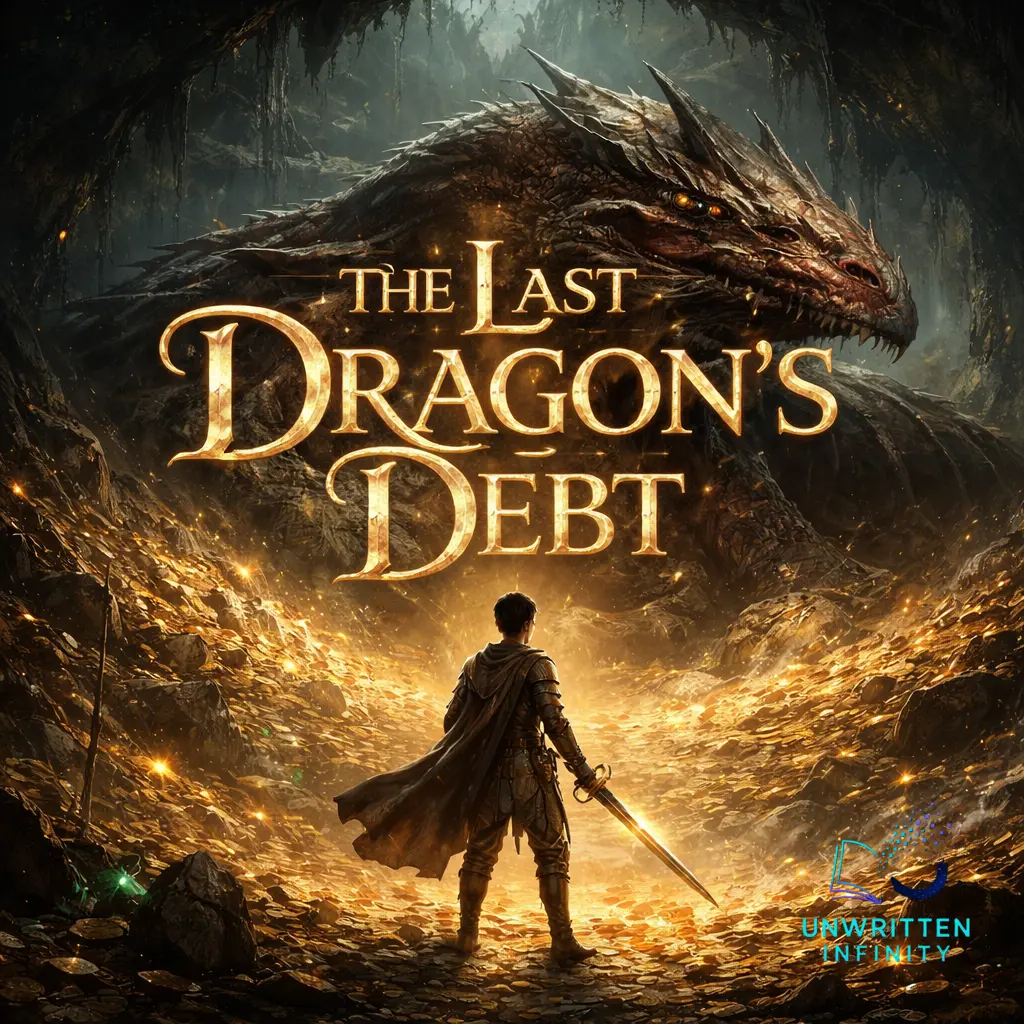
The Last Dragon’s Debt
As a dragon’s hoard turns to lead and magic fades, a cynical lawyer must uncover why the chosen hero is destined to kill the dragon—and become him.
The first thing Halverin noticed was the taste.
Not fear, not awe—though both came a breath later—but the taste. Bitter. Metallic. Like sucking on a coin left too long in a gutter. It coated his tongue as he stepped across the threshold of the cavern, as if the air itself had been steeped in old money and left to rot.
He paused, one hand still resting on the stone arch behind him, and swallowed hard.
“Occupational hazard,” he muttered to no one. Then, louder: “Master Virexal? I presume this is your residence.”
A slow exhale answered him, stirring the dust into languid spirals. The cavern was vast, but it felt… diminished. The ceiling sagged where stalactites had broken and never regrown. Once, Halverin imagined, this place must have glittered. Now it dulled the eye.
The hoard lay before him like a tarnished sea.
Not gold. Not anymore. Thousands—tens of thousands—of coins and chalices and crowns lay heaped in uneven drifts, their luster gone. What should have burned with warm, honeyed light instead sat in a sullen, gray weight. Lead. All of it.
Halverin approached cautiously, boots crunching against metal that should have sung but only thudded.
“I had hoped,” came a voice from the dark, “that you would pretend otherwise.”
Halverin looked up.
The dragon lay coiled in the shadowed rear of the cavern, his bulk so immense that it took a moment for Halverin’s eyes to adjust and trace the outline. His scales—once, surely, a magnificent red or gold—had faded to the color of old embers. His wings were folded tight against his body, the membranes thin and veined, like parchment left too long in the sun.
One eye opened. It was clouded, but not blind.
“You are late,” the dragon said.
“I am punctual,” Halverin replied, producing a pocket watch and snapping it open. “You are early in your expectations.”
The dragon made a sound that might once have been a laugh. Now it was just a rasp.
“Come closer, lawyer.”
Halverin hesitated, then did as he was bid. He had argued before kings, merchants, even a lich who had refused to acknowledge his own death certificate. A dragon, he reminded himself, was simply a client with unusual dietary preferences.
He stopped a safe distance from the dragon’s head and inclined it politely.
“Halverin Doss, Advocate of the Seventh Charter. You engaged my services to draft a binding testament regarding the disposition of your assets.”
“My treasure,” the dragon corrected.
Halverin gestured toward the dull expanse behind him. “With respect, Master Virexal, we may need to address the definition of that term.”
A pause. Then: “You can taste it, can’t you?”
Halverin swallowed again, trying to ignore the lingering bitterness on his tongue.
“Yes.”
“It is the magic leaving,” the dragon said. “Gold is not merely metal, Advocate. It is… memory. Heat. Story made solid. When the stories fade, when the world forgets how to believe, the gold forgets how to be gold.”
Halverin made a small note on his parchment. Client prone to metaphor. Possibly delusional. Cross-reference with alchemical degradation?
“And yet,” he said, “the neighboring kingdom does not seem to share your philosophical concerns. Their envoys were quite explicit. They believe you still possess wealth worth seizing.”
“They smell the past,” Virexal said. “They do not yet understand that it is already gone.”
“Nevertheless,” Halverin said, “they will arrive within a fortnight. You have requested that your hoard be distributed before then, to a ‘true hero.’ My task is to ensure that your wishes are carried out with legal rigor. To that end, I will require clarification.”
The dragon’s eye sharpened slightly.
“Ask.”
Halverin adjusted his spectacles.
“Define ‘true hero.’”
The cavern seemed to grow quieter.
“A hero,” Virexal said slowly, “is one who ends what must be ended.”
Halverin frowned. “That is… imprecise. There are numerous claimants who would argue themselves fit under such a definition.”
“Of course there are,” the dragon said. “That is why I have already chosen.”
Halverin’s pen stilled.
“You have selected a beneficiary?”
“Yes.”
“And where is this individual now?”
“On their way.”
Halverin exhaled, a thin thread of patience unraveling.
“With respect, Master Virexal, it would have been helpful to disclose that prior to my arrival. I will need to verify their identity, assess their claim, and ensure that no competing interests can legally contest the transfer.”
“There will be no contest,” the dragon said.
“There is always a contest,” Halverin replied. “That is why people hire me.”
The dragon shifted, a low groan of ancient bones.
“You will understand,” he said, “when they arrive.”
The second time Halverin tasted it was hours later, when the dragon spoke of flight.
They had settled into a rhythm of questions and answers, Halverin’s parchment filling with clauses, contingencies, and definitions that felt increasingly absurd the longer he remained in the cavern.
“State of health?” Halverin asked, not looking up.
“I am dying,” Virexal said.
“Cause?”
“Time.”
Halverin sighed. “Be specific.”
The dragon’s tail flicked, sending a small cascade of lead coins sliding.
“I cannot fly,” he said. “My wings remember how, but my body does not. The sky has… receded from me.”
Halverin finally looked up.
“You are a dragon.”
“I was a dragon,” Virexal corrected. “Now I am something that used to be one.”
The words hung in the air.
Halverin opened his mouth to respond, then closed it again. For a moment, something unfamiliar stirred at the edges of his mind—an echo of childhood stories, of fire and terror and wonder.
It tasted like copper, sharp and unpleasant.
He cleared his throat.
“Very well. We will include a clause acknowledging your… diminished capabilities. Now, regarding the selection criteria for your heir—”
“They are not my heir,” the dragon said. “They are my answer.”
Halverin pinched the bridge of his nose.
“Clients who speak in riddles often find their estates tied up in litigation for decades,” he said. “If you wish to avoid that outcome, I suggest—”
A sound echoed from the cavern entrance.
Footsteps.
Halverin turned.
A figure stood silhouetted against the pale light outside. Human. Slight. Cloaked in travel-worn gray.
“Well,” Halverin said, straightening his coat. “At last.”
The figure stepped forward, and the light fell across their face.
Young. No more than twenty. Their hair was dark, their expression calm—too calm, Halverin thought, for someone standing in a dragon’s lair.
They carried a sword.
Of course they did.
“State your name,” Halverin said crisply.
The young person hesitated, then said, “I… don’t think it matters.”
“It matters to me,” Halverin said. “And to the legal record.”
Another pause.
“Call me Ash,” they said finally.
Halverin scribbled it down.
“Ash. Very well. You claim to be the individual selected by Master Virexal as the recipient of his estate?”
“I didn’t claim anything,” Ash said. “He called me.”
Halverin’s pen stopped.
“You received a summons?”
Ash nodded. “In a dream.”
Halverin closed his eyes briefly.
“Of course you did.”
He turned to the dragon.
“Master Virexal, I must insist on a more conventional method of—”
“Look at them,” the dragon said.
Halverin did.
There was nothing remarkable about Ash. No gleaming armor, no aura of destiny. Just a tired young person with a sword that looked like it had seen too much use for its age.
“This is your ‘true hero’?” Halverin asked.
“Yes.”
Halverin exhaled slowly.
“Very well,” he said. “Then we proceed to verification.”
He stepped toward Ash, adopting the tone he reserved for particularly fragile witnesses.
“Have you performed any acts of notable heroism? Slain beasts, saved villages, overthrown tyrants?”
Ash shook their head.
“No.”
“Any formal training in combat?”
“A little.”
“Any divine endorsement? Prophecy? Lineage of significance?”
“No.”
Halverin glanced back at the dragon.
“I fail to see—”
“They will kill me,” Virexal said.
The words landed with a dull finality.
Ash flinched.
Halverin stared.
“I beg your pardon?”
“They will kill me,” the dragon repeated. “And in doing so, they will fulfill the only act that matters.”
Halverin felt the bitter taste surge again, stronger this time.
“This is… irregular,” he said. “You are proposing that your chosen beneficiary must commit an act of—of lethal violence against you as a condition of inheritance?”
“Yes.”
“That is not legally enforceable,” Halverin said sharply. “Nor is it ethically—”
“It is necessary,” the dragon said.
Silence.
Halverin looked at Ash.
“Do you understand what is being asked of you?”
Ash swallowed.
“I think so.”
“And you agree to it?”
Ash hesitated.
“I… don’t know.”
“Then we cannot proceed,” Halverin said. “Consent must be clear and unambiguous. Anything less—”
“Advocate,” the dragon said, his voice softer now. “Have you ever wondered why your world tastes the way it does?”
Halverin froze.
“What?”
“The bitterness,” Virexal said. “The way everything feels… diminished. As if something essential has been leeched away.”
Halverin did not answer.
“Magic is not a thing,” the dragon continued. “It is a cycle. It rises, it burns, it fades. And when it fades too far…” He closed his eye briefly. “It must be kindled again.”
Halverin’s grip tightened on his pen.
“And you believe your death will accomplish this?”
“I know it will,” Virexal said.
Halverin let out a humorless laugh.
“You expect me to draft a legally binding document that hinges on the metaphysical restoration of a dying force through ritualized self-slaughter?”
“Yes.”
Halverin looked at Ash again.
“And you?” he asked quietly. “Do you believe this?”
Ash met his gaze.
“I don’t know what I believe,” they said. “But I know I couldn’t ignore the call.”
Halverin studied them for a long moment.
Then he turned back to his parchment.
“Very well,” he said. “We will draft it.”
The third time the taste came, it was unbearable.
The document lay complete between them, ink drying in the cold air. Halverin had done his work—defined terms, established conditions, sealed it with every legal safeguard he knew.
Upon the voluntary slaying of Virexal by the designated individual known as Ash, the entirety of the hoard shall transfer…
It was absurd. It was meticulous. It was, he suspected, utterly meaningless.
“Sign,” he said, offering the quill to the dragon.
Virexal lowered his head, pressing a claw to the parchment. The mark he left was less a signature than a wound.
Halverin turned to Ash.
“You as well.”
Ash took the quill, hands trembling slightly, and signed.
It was done.
Halverin rolled up the document carefully.
“Legally binding,” he said. “For whatever that is worth.”
“Thank you,” the dragon said.
Halverin nodded curtly.
Then he stepped back.
“I believe my services are concluded.”
He should leave. He knew that. There was nothing more for him here.
And yet he did not move.
Ash stood across from the dragon, sword still sheathed.
“I don’t want to do this,” they said.
“I know,” Virexal replied.
“Then why—”
“Because you already have,” the dragon said gently.
Ash frowned.
“I don’t understand.”
The dragon’s eye fixed on them, clear now in a way it had not been before.
“You are what remains,” he said. “What I chose to become when I could no longer remain as I was.”
The cavern seemed to tilt.
Halverin felt the metallic taste flood his mouth, sharp and overwhelming.
“Ash,” the dragon said, “is what I called myself when I first woke in a body that could not remember the sky.”
Ash’s breath hitched.
“No.”
“Yes.”
Halverin stared between them, comprehension dawning with cold precision.
“Reincarnation,” he said softly. “You intend to… reset the cycle.”
“I intend to continue it,” Virexal said. “Magic does not persist. It renews.”
Ash shook their head, backing away.
“I’m not you.”
“You are what comes after me,” the dragon said. “That is enough.”
Silence stretched.
Then Ash’s hand went to the sword.
Halverin took an involuntary step forward.
“This is madness,” he said. “You are asking them to annihilate themselves—to become something else entirely—on the basis of—”
“Of necessity,” the dragon said.
Halverin stopped.
For a moment, he saw it—truly saw it. The cavern, the dead hoard, the fading world. The long, slow erosion of something once vast and luminous.
He thought of the taste that had followed him for years, growing stronger, more persistent.
He thought of a time—dim, distant—when stories had felt real.
Ash drew the sword.
It was not a grand weapon. Just steel, worn and honest.
They stepped forward, tears on their face.
“I’m afraid,” they whispered.
“So was I,” the dragon said.
The blade rose.
Halverin opened his mouth to object, to argue, to do something—
But no words came.
The sword fell.
The sound was not a roar, nor a crash. Just a soft, final exhale.
The cavern went still.
For a heartbeat, nothing happened.
Then—
A flicker.
Gold.
Not everywhere. Not all at once. But here and there, like embers catching.
A coin near Halverin’s boot brightened, its dull gray giving way to a faint, warm glow.
He stared at it, breath held.
The taste in his mouth shifted.
Still metallic—but no longer bitter. Not entirely.
Ash stood where they had struck, the sword lowered. Their form… wavered.
For an instant, Halverin thought he saw something vast behind them—wings, fire, memory.
Then it was gone.
Ash collapsed.
Halverin rushed forward, dropping to his knees.
“Ash?” he said, shaking them gently.
Their eyes fluttered open.
They looked at him—and for a moment, there was something ancient in that gaze.
Then it faded.
“Did it work?” they asked.
Halverin looked around.
The hoard still lay mostly dull. The cavern still sagged. The world beyond still waited, hungry and gray.
But here and there, small points of gold persisted.
“It… began,” he said.
Ash smiled faintly.
“Good.”
They closed their eyes.
Halverin sat back slowly.
He picked up a coin—one of the newly brightened ones—and turned it in his fingers. It was warm.
Real.
For the first time in years, he did not taste bitterness.
He looked at the body of the dragon—already fading, as if it had never quite belonged to this world.
He looked at Ash—at what they had been, and what they might become.
He thought of the document in his coat, precise and careful and utterly inadequate.
A lawyer’s attempt to bind something that could not be contained.
He let out a long breath.
Then he stood.
There would be arguments. Claims. A kingdom would still come, eager to seize what little remained.
There would be work.
But for the first time in a long while, Halverin found that he did not entirely dread it.
He glanced once more at the scattered points of gold, fragile and flickering.
A beginning, perhaps. Or just a delay.
Either way, it would not last.
Nothing did.
He turned and walked toward the light, the taste of metal lingering faintly on his tongue—not bitter now, but not sweet either.
Just a reminder.
That even wonder, like everything else, was subject to time.
And that, in the end, all things—magic, dragons, and even hope—must answer to the quiet, inevitable law of obsolescence.