The Glass Slipper’s Shard
A royal cobbler must remove a glass slipper fused to a princess's bone, but she chose this fate to escape a prophecy, and the Queen will not forgive failure.
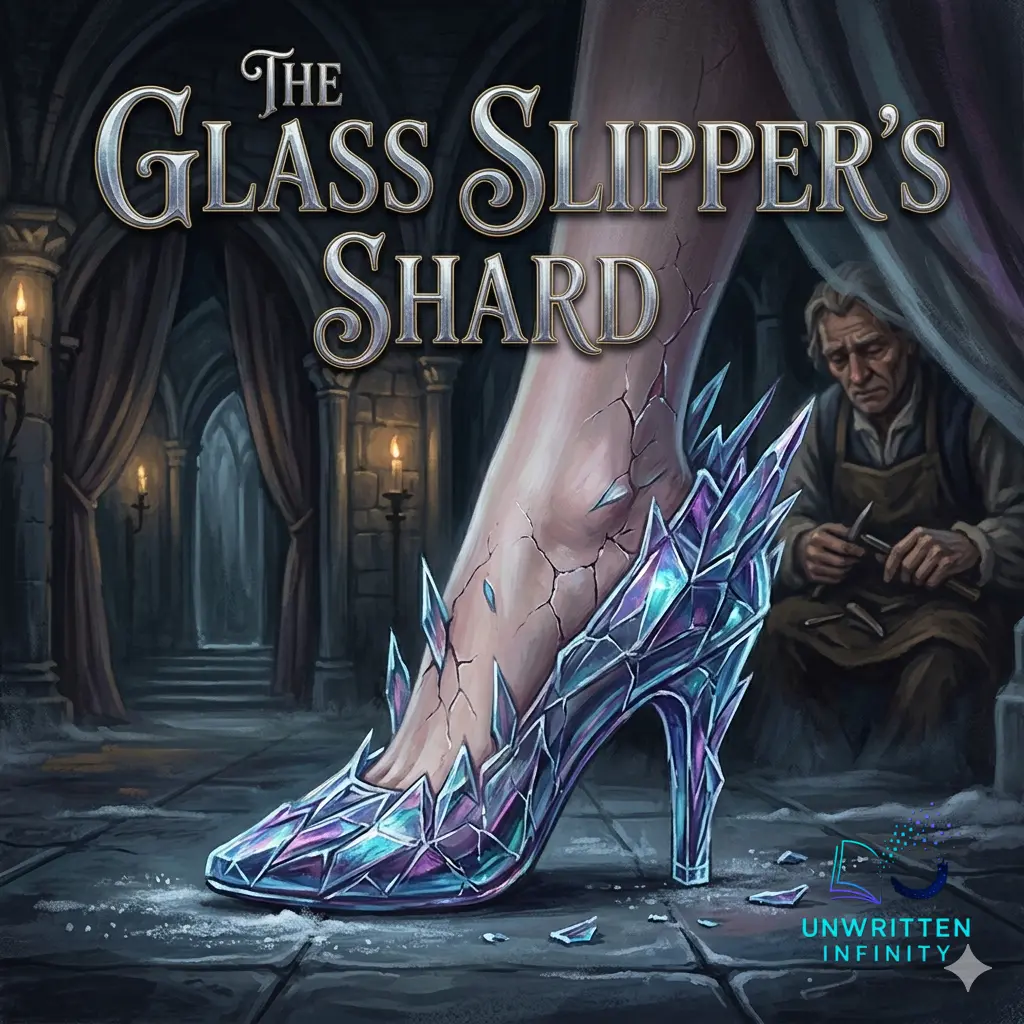
They brought me to the palace at the third hour of the false morning, when the eclipse had settled so completely over the kingdom that men had stopped looking up, convinced the sun was simply gone. The guards did not knock at my workshop door so much as remove it from its hinges, and I understood then that I was not being invited.
I am Aldric, cobbler to the Crown for thirty-one years. I have fitted slippers onto the feet of queens and boots onto the legs of generals. I have stretched leather over grief and stitched silk over ambition. I know feet the way a physician knows faces — every scar tells a story, every callus is a confession. But nothing in three decades of craft had prepared me for what I carried in my hands as they led me through the palace corridors: my own tools, my own needles and wedges and fine-boned files, summoned as instruments of correction for a creation that should never have been made.
The marble floors of the palace were cracked along their length, roots of darkness spreading through the white stone like veins through a corpse. The tapestries hung waterlogged with damp. Somewhere deep inside the building, water was moving through walls it should not have been moving through, and the whole structure breathed with the slow patience of something dying but not yet dead.
I heard her before I saw her.
Crack.
The sound split the corridor ahead of me like a fault opening in winter ice — sharp, crystalline, horribly delicate. Then again. Then again. Each footfall a small catastrophe of sound, as though the floor itself was flinching away from contact with her.
The Princess Seraphine stood at the end of the hall.
She was seventeen, or had been when I made the shoes. That was eight months ago, commissioned by the Queen for the Celestial Ball — the shoes were to be my masterwork, my legacy. I had blown the glass myself with a craftsman I trusted, ground the soles to a tolerance of a hair’s width, fitted them with inner cushions of lamb’s wool so fine the Princess would feel she was walking on still water. They had been perfect. I had wept when I finished them. I had believed, in the fullest and most foolish corner of my heart, that I had made something beautiful.
Now I watched Seraphine walk toward me and I understood what beauty costs when it is worn too long.
The Queen received me in the surgery chamber — they called it that, though it had never held a surgeon. It was a room of white stone and iron brackets where the palace’s old instruments hung rusting on the walls, and the Queen stood at its center with the particular stillness of someone who has decided that stillness is a form of threat.
“Master Aldric.” Her voice was a closed door. “My daughter cannot remove the shoes.”
“Your Majesty.” I bowed. “I was told they had — that there was some difficulty with—”
“They have grown into her.” The Queen turned and looked at the door through which Seraphine had not yet entered. “The glass. It has adhered to the bone. The physicians say it cannot be removed without killing her. You will remove it without killing her.”
I stood there with my bag of tools and felt every year of my age settle into my joints at once.
“Your Majesty, I am a cobbler. I work in leather and thread. Glass fused to living bone is—”
“Is your work.” She turned those flat eyes to me, and I understood for the first time that the room’s cold had nothing to do with temperature. “You made them. You will unmake them. And if Seraphine does not walk from this room on her own feet by morning, you will not walk from this palace at all.”
The door opened. The Princess entered.
I had not seen her up close since the fitting. The girl who had stood laughing in my workshop, turning before the mirror, was somewhere inside the creature before me, but she had been papered over by something else, something that wore her face without quite understanding how it worked. Her eyes were the wrong temperature. Her smile, when she gave it, arrived a moment after it should have.
“Master Cobbler.” Her voice was pleasant and entirely empty. “I hear you’ve come to hurt me.”
“I’ve come to help you,” I said carefully.
“That tends to be the same thing.” She sat in the iron chair they had prepared and extended her legs. “Go ahead. Look.”
I have no medical education. I want that on record, though there is no record being kept and no one alive who will remember my name when this is over. I examined Seraphine’s feet with the instruments I had brought and with a lantern held close, and what I found there unmade something in me permanently.
The glass had not merely adhered. It had been invited. Along the sole and up the sides of both feet, the skin had grown over the glass edges in smooth, healed ridges — not the raw tissue of a wound but the settled flesh of accommodation. The body had accepted the shoes as part of itself. The shoe had accepted the body in return. They had made an agreement without consulting anyone.
I sat back on my heels and looked up at her.
“How long,” I asked quietly, “did you wear them without removing them?”
“I have not removed them,” she said, “since the night of the Ball.”
“Eight months.”
“Has it been?” She tilted her head with that delayed curiosity. “Time moves strangely when you’re not entirely present for it.”
“Seraphine.” I kept my voice low, aware of the Queen watching from her corner. “I need you to understand that what I have to do will cause you pain.”
“Master Aldric.” She leaned forward, and her eyes found mine with sudden and terrifying clarity. “I need you to understand that I cannot feel my feet.”
The silence that followed had weight.
“The shoes,” I began.
“Were a door,” she said. “And I walked through it.” She glanced at her mother, then back to me, and something passed through her expression like a ship passing through fog — there and then not. “There was a prophecy. Perhaps you’ve heard of it. The third daughter of the eclipse queen will pull the sun back to its place, but only by burning from the ground up.” She said it the way one recites something memorized so long ago it has lost all meaning except as sound. “Burning from the ground up, Master Cobbler. Beginning with the feet.”
I stared at her.
“I found another way,” she said, simply. “I stepped out of my own fate. The shoes were a vessel. I poured myself into them and let the glass hold what I could not carry. I am still here. Mostly.” The almost-smile again, slightly mistimed. “The parts of me that were meant to burn are in the glass now. You’ll feel them when you work.”
Behind me, the Queen said nothing. She had known. I understood then that she had known all of it, and that was the particular horror she lived inside.
I picked up my finest separation tool and began.
I will not describe the work in detail because some truths are merciful when left in the dark. I will say only that it took four hours, that the Princess did not scream because she could not feel it, and that I screamed instead, once, when a shard came free and rang against the stone floor with a sound like a voice.
At the climax of it — the deep glass, the anchor piece that had taken root along the arch of her left foot — the tool slipped. The shard cracked under the pressure, splitting not cleanly but along some internal fault, and the sound it made was the sound of ice breaking beneath a person who was almost certainly too heavy to be walking there: crack, crystalline and spreading, echo tumbling away into the dark chamber until silence swallowed it.
Seraphine looked at me. For just a moment, something crossed her face that was entirely and unmistakably human. Grief, I think. Or memory.
“That was the last piece,” she said quietly. “I felt that one.”
When I finished, she stood. Her feet were wrapped in linen, bleeding through already, but she stood unaided and she stood straight. She took one step and then another. The Queen moved toward her, but Seraphine raised one hand and the Queen stopped.
She walked to the window. Below, the kingdom lay under its eternal eclipse, the absence where the sun had been a black coin pressed against the sky. She looked at it for a long time.
“Well,” she said.
Outside, in the dark, something shifted. I cannot explain it clinically. I can only say that the black coin moved, and that along its edge a thread of gold appeared, thin as a wire, hot as promise.
Seraphine put her wrapped hand against the glass.
“It seems,” she said, to no one in particular, “that I am going to burn after all.”
They let me leave before dawn.
I walked home through the kingdom in the first grey light of a sun that was returning too late for some things and exactly on time for others. My bag of tools hung from my shoulder and I could feel, though I told myself I could not, the warmth of glass fragments inside it — pieces I had wrapped in cloth and could not bring myself to leave behind.
I do not know what happened to Seraphine after I left. I do not know whether the sun came back, or whether the burning was literal or metaphorical, or whether a prophecy satisfied still leaves anything behind worth calling a life.
I know that I made a beautiful thing.
I know that beauty, when it is worn as armor against the world, will fuse to the bone if you leave it on long enough.
I know that as I set my bag down in my empty workshop and heard, one final time, a sound like ice cracking — a single shard settling against its brothers in the dark of the bag — I sat down at my bench and did not pick up my tools again for a very long time.
She had paid for my craftsmanship with what remained of herself.
Some prices, once paid, cannot be refunded — only worn.