The Clockwork Dryad
In a forest of brass gears, an obsessed inventor tries to wind up the last living tree, only to learn nature isn't dying, it's arming itself.
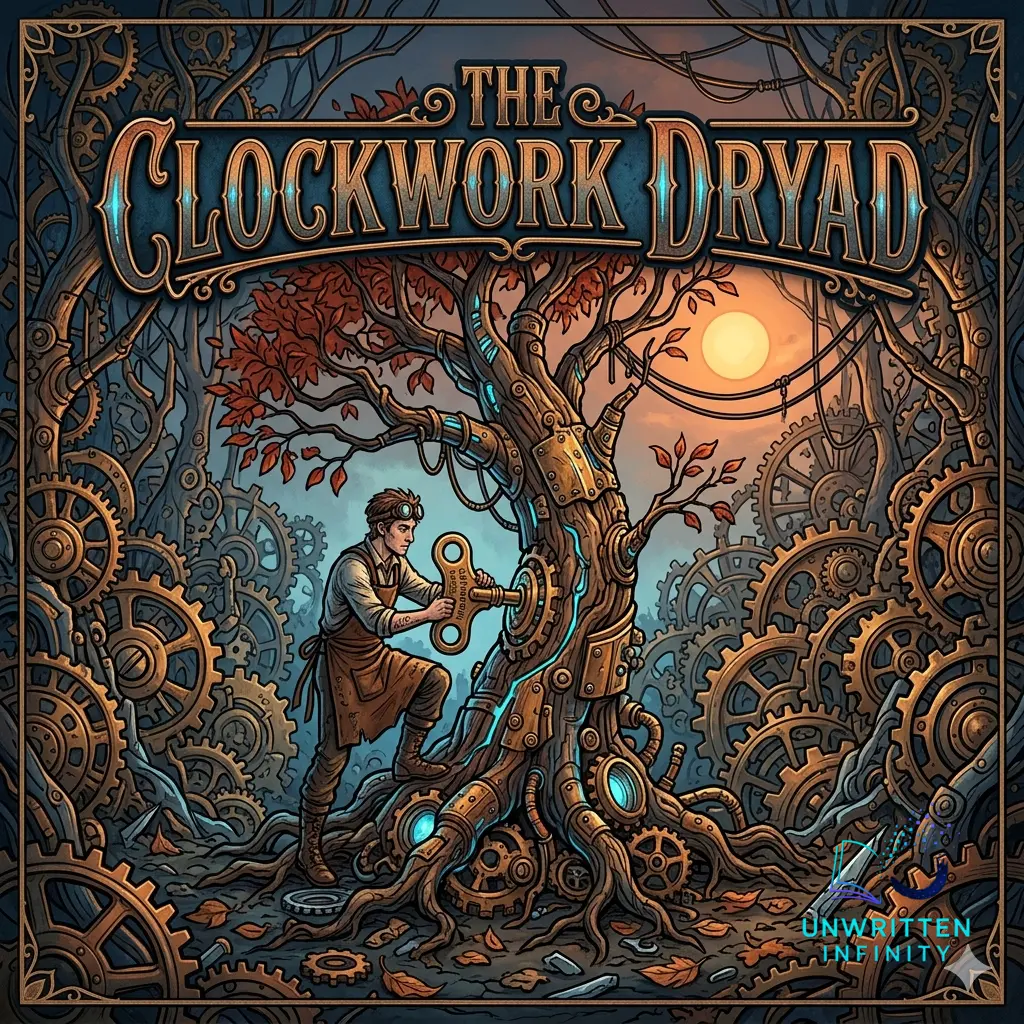
The forest did not rustle; it chimed. Barnaby stood at the edge of the Copper Glade, his boots crunching over a carpet of brass shavings and discarded copper pins. Above him, the canopy was a rigid interlocking of verdigris-stained gears and wrought-iron boughs. There were no birds, only mechanical hummingbirds that zipped on clockwork wings, their songs a series of pre-recorded whistles etched into tiny silver cylinders. In the center of this metallic purgatory stood the Anomaly: a gnarled, stubborn Rowan tree. It was the last thing in the world that possessed a pulse instead of a pendulum. But today, the Rowan was failing. Its leaves, once a defiant crimson, were curling into brittle, gray husks. “Just a timing issue,” Barnaby whispered, his fingers trembling as he adjusted his brass-rimmed goggles. “A simple misalignment of the seasonal intake.” He approached the trunk, his leather satchel clinking with the weight of specialized wrenches. To Barnaby, the tree was not a miracle; it was a poorly maintained engine. He had spent his life ‘perfecting’ the wild, replacing the chaotic, rotting biology of the woods with the clean, predictable logic of steam and gear. He reached into his pocket and withdrew a heavy, ornate winding key. He pressed it into a knot in the bark he had hollowed out weeks prior, fitting it into a custom-made socket he’d bolted directly into the sapwood. Click. Click. Click. The rhythmic, metallic clicking echoed through the silent woods, a sharp, artificial heartbeat that seemed to bruise the quiet air. Barnaby grinned. If he could just provide enough torque, he could force the sap to rise. He could automate the spring. By noon, the humidity of the mechanical forest was stifling. The brass trees vented steam at regular intervals, creating a faux-mist that smelled of oil and hot solder. Barnaby was chest-deep in the Rowan’s roots, which he had partially excavated to install a series of hydraulic bellows. “You’re seizing up on me,” he muttered, wiping grease across his forehead. He patted a thick, wooden root that felt disturbingly feverish to the touch. “The friction of existence is wearing you down, old girl. But I have the grease. I have the gears.” He viewed the wilting leaves not as a sign of death, but as a mechanical failure—a “low-power mode” that required his intervention. He began to bypass the tree’s natural vascular system, threading flexible copper tubing around the trunk to deliver a nutrient-rich slurry of his own design. As he tightened a clamp, the entire forest seemed to groan. The massive gears in the sky—the ones that controlled the “sunlight” filtration—shuddered. A total mechanical seizure was imminent; the forest’s central engine was overtaxed, trying to compensate for the Rowan’s “inefficiency.” Barnaby ignored the warning sirens of the steam-whistles in the distance. He grabbed the winding key again, inserting it into the secondary regulator he’d installed near the first branch. Click. Click. Click. The sound was louder now, a frantic staccato. Barnaby’s eyes were bloodshot. He was a man trying to jumpstart a god with a hand-crank. He believed, with the holy fervor of a master horologist, that the soul was merely a very complex spring. If the tree died, it was because he wasn’t a good enough mechanic. The sun—a glowing phosphorus orb suspended by cables—began its programmed descent. The shadows cast by the brass trees were sharp and serrated. Barnaby was exhausted. The Rowan looked worse than ever. The copper tubes were bulging, and the bark was splitting where he had bolted the stabilizers. The tree wasn’t drinking; it was rejecting the transfusion. “Work, damn you,” he hissed, leaning his full weight against the winding key. “I am saving you! Without me, you are just timber. With me, you are eternal!” He gave the key one final, desperate turn. Click. Click. Click. The sound didn’t stop this time. It surged. But the clicking wasn’t coming from Barnaby’s key. It was coming from inside the bark. Suddenly, the Rowan convulsed. The copper tubes snapped like dry twigs. The hydraulic bellows were crushed instantly as the roots expanded with a violent, terrifying strength. Barnaby fell back, his goggles slipping from his face. He watched in horror—and then a strange, hollow wonder—as the tree began to move. It wasn’t wilting. It was shedding. The gray, brittle leaves fell away, but they weren’t replaced by green. Instead, the tree began to draw the surrounding metal toward itself. The brass shavings on the ground flew up like iron filings to a magnet. The copper pins, the discarded gears, and even Barnaby’s own wrenches were pulled into the Rowan’s embrace. The tree wasn’t dying of a “seizure”; it was starving for the very thing Barnaby had used to replace it. The Rowan didn’t want to be fixed; it wanted to consume the fixer. It wove the brass into its fiber, turning its soft wood into a reinforced alloy. It used the inventor’s “upgrades” as a scaffolding for a new, predatory evolution. The tree reached out with a branch that was half-oak, half-piston, and gently plucked the winding key from Barnaby’s hand. Barnaby realized then, as the forest’s mechanical humming fell silent in the presence of a superior power, that he had never been the architect. He had merely been the delivery boy, bringing the metal to the mouth of the wild. The inventor had spent his life trying to teach the tree how to be a machine, never realizing the tree was simply waiting to learn how to wear the machine as armor. Nature does not require a key to run; it only requires the arrogance of man to provide the parts for its next transformation.