Pigeon Post Noir
A noir detective who trusts only pigeons follows a murder into the dark, never suspecting the flock are dead children watching for a believer—to complete their vengeance.
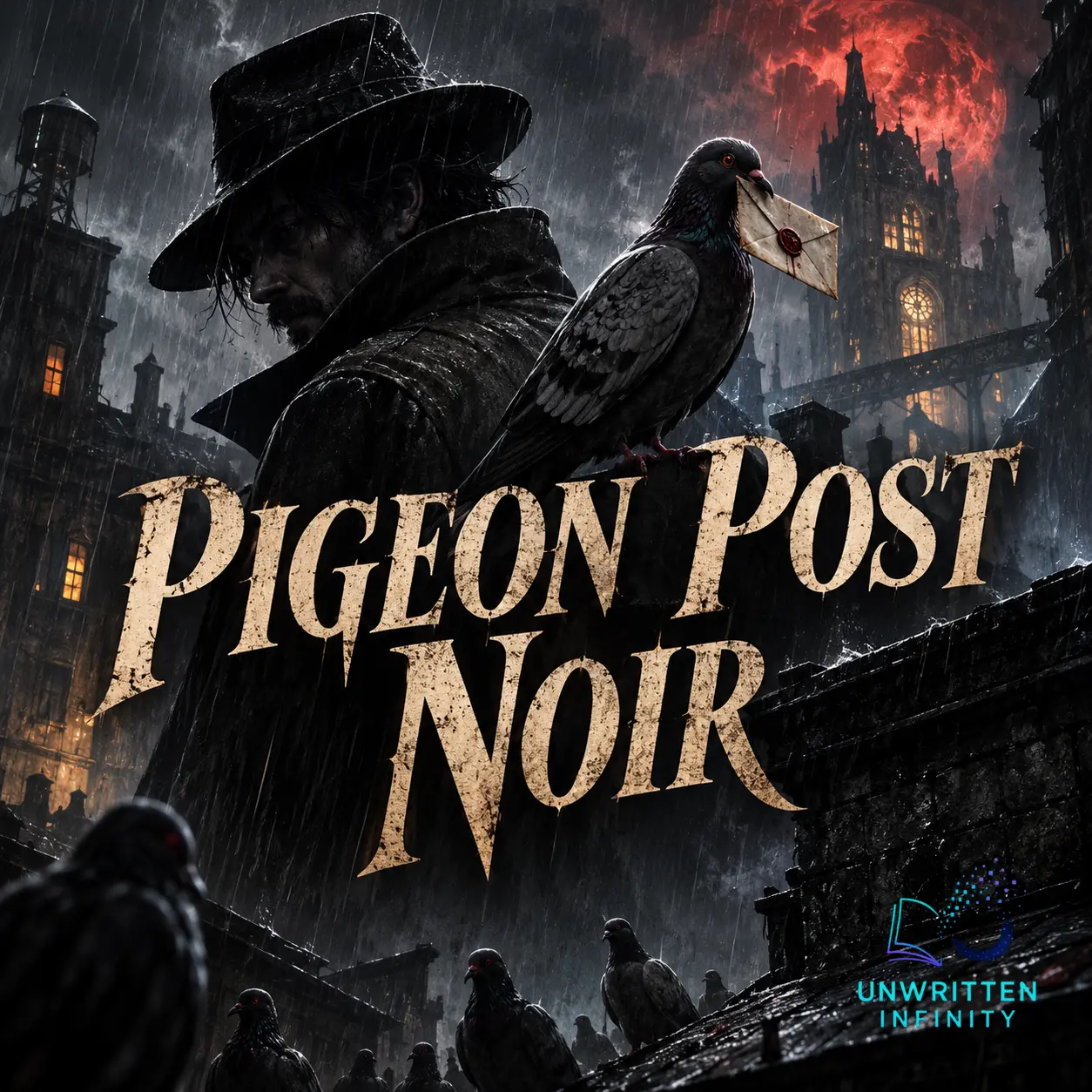
The rain in the Lower Ward didn’t wash things clean; it just made the grime slicker, turning the cobblestones into a black mirror that reflected nothing but the bruised purple of the sky. Elias Thorne pulled the collar of his trench coat up, the wool damp and heavy against his neck. He stood under the awning of a shuttered bakery, watching the street. To anyone else, it was a desolate stretch of crumbling tenements where the streetlights flickered like dying stars. To Elias, it was a hive.
He wasn’t looking for people. People lied. People had alibis, motives, and the ability to look you in the eye while stabbing you in the back. Elias looked up.
Above him, perched on the rusted fire escapes and the jagged edges of broken gargoyles, sat the flock. Hundreds of them. Gray, iridescent, eyes like polished obsidian. They were silent, save for the occasional coo that sounded too much like a whisper.
Elias had lost his badge three years ago, and his sight five years before that. Not his physical vision—he could see the peeling paint and the overflowing gutters just fine. He had lost the other sight. The one that let him see the magic bleeding through the cracks of the city, the one that let him believe the world wasn’t just a meat grinder. He had stopped believing in anything good, and the magic had receded, leaving him blind to the supernatural currents that flowed beneath the asphalt.
But the pigeons remained. And lately, they had started talking again.
It began with a scratch.
Scritch-scratch. Scritch-scratch.
The sound came from the tin roof of the alleyway next to him. It was a frantic, rhythmic noise, like a thousand tiny fingernails dragging across metal. Elias flinched, his hand instinctively going to the empty holster at his hip. He hadn’t carried a gun in months. He didn’t need one. He needed the birds.
He tilted his head back. A single pigeon, larger than the rest with feathers the color of a storm cloud, was pecking at a loose sheet of corrugated iron. The sound was maddening, a staccato beat that drilled into his skull.
“Alright, alright,” Elias muttered, his voice raspy from disuse. “What is it? Another one?”
The bird stopped. It turned its head, fixing him with a gaze that held no animal instinct, only a cold, human intelligence. Then, it took flight, circling once before diving toward the old textile mill at the end of the block.
Elias followed.
The textile mill was a skeleton of brick and rusted steel, a place where the shapeshifters liked to hunt. They were the new predators of the city, creatures that wore human skin like ill-fitting suits, slipping into society to feed on the unsuspecting. The police called them “muggers” or “drunks.” Elias knew better. He had seen the way their shadows moved independently of their bodies.
He pushed through the rotting doors, the smell of wet dust and ozone hitting him. The interior was vast, a cavernous space filled with the skeletons of looms. Rain hammered the skylights above, creating a drumming rhythm that competed with the memory of the scratching.
“You’re late, Detective,” a voice said.
Elias spun around. Standing in the center of the room was a man in a pristine suit, his face smooth, almost too symmetrical. But the eyes were wrong. They shifted color, swirling from brown to green to a sickly yellow. A shapeshifter.
“I’m not a detective anymore,” Elias said, keeping his hands visible. “And I’m not here to arrest you. I’m here to ask who killed the boy.”
The shapeshifter smiled, a gesture that didn’t reach those shifting eyes. “The boy? Which one? There are so many in this city. So many little secrets.”
“The one in the alley behind the bakery. The one with the blue scarf.”
The shapeshifter laughed, a sound like grinding glass. “We don’t kill them, Detective. We recycle them. Their fear is potent. Their confusion… delicious. But you’re asking the wrong questions. You think you’re hunting us? You think you’re the predator here?”
Elias narrowed his eyes. He focused on the flock. They were everywhere now, perched on the rafters, the beams, the broken machinery. They weren’t cooing. They were watching.
“I know what you are,” Elias said, stepping forward. “I know you wear faces that aren’t yours. I know you leave the city’s children in the gutters.”
“And you know nothing,” the shapeshifter sneered. “You’re a broken man chasing ghosts. You lost your sight because you stopped believing. And without belief, you are blind to the truth.”
The shapeshifter lunged, moving with a speed that blurred the air. Elias didn’t try to dodge; he couldn’t. Instead, he threw his head back and shouted, “Now!”
The flock descended.
It wasn’t a chaotic dive. It was a coordinated strike. Hundreds of birds slammed into the shapeshifter, a wall of gray feathers and sharp beaks. The creature screamed, a sound that wasn’t human, tearing through the silence of the mill. The birds tore at the suit, pecking at the skin beneath, revealing the writhing, shadowy mass underneath.
Elias watched, his heart hammering against his ribs. For a moment, the world seemed to sharpen. The rain outside looked like silver needles. The shadows of the birds cast shapes that looked like children running. He felt a spark in his chest, a warmth he hadn’t felt in years. The sight was returning. He could see the magic, the threads of life and death connecting the birds to the city.
But then, the shapeshifter broke free. It shed the suit entirely, becoming a writhing mass of darkness that lashed out, knocking Elias backward. He hit the ground hard, the wind knocked out of him.
The creature loomed over him, its form shifting rapidly—face, face, face. “You think you won?” it hissed. “You think the birds are your allies?”
Elias struggled to sit up. “They’re… they’re the witnesses.”
“They are the victims,” the creature corrected, its voice echoing from all directions. “Look closer, Detective. Really look.”
Elias squinted, forcing his eyes to focus past the pain. He looked at the birds swarming the creature. He looked at their eyes. They weren’t just black beads. They were filled with memories. He saw a flash of a blue scarf. He saw a small hand reaching out. He saw a mother crying in the rain.
The realization hit him like a physical blow. The pigeons weren’t just informants. They weren’t just spirits of the dead. They were the souls of the murdered children, trapped in the city, forced to watch, forced to wait. And they weren’t leading him to justice.
They were leading him to the slaughterhouse.
The scratching started again.
Scritch-scratch. Scritch-scratch.
It was louder this time, coming from everywhere. The tin roof, the walls, the floor. It was the sound of a thousand tiny claws, frantic and desperate.
“Why?” Elias whispered, the horror rising in his throat. “Why bring me here?”
The shapeshifter laughed, a sound of pure malice. “Because we needed a witness. Someone who could see. Someone who could believe enough to make the ritual complete. Your sight, Detective. Your belief. That’s the final ingredient. You think you’re solving a murder? You’re the sacrifice.”
The birds stopped attacking the shapeshifter. They turned. All of them. Hundreds of pairs of eyes locked onto Elias. They didn’t look angry. They looked sad. They looked like children who had been waiting a long time for someone to come home.
Elias scrambled backward, his hand finding a piece of broken brick. “No,” he gasped. “I believed. I believed in you.”
“That’s the tragedy,” the shapeshifter said, stepping closer. “Belief is a powerful thing. It binds you. It ties you to the world. And now, you belong to it.”
The flock surged forward. Not to attack, but to embrace. They swarmed over him, a living blanket of gray. Elias felt the weight of them, the coldness of their feathers, the warmth of their tiny hearts. He felt the memories flooding into him—the fear, the pain, the loneliness of every child who had died in this city.
He tried to scream, but the birds filled his mouth. He tried to run, but his legs were pinned by the weight of the flock. The scratching was deafening now, a cacophony of claws on bone, on metal, on soul.
Scritch-scratch. Scritch-scratch.
The sound was inside his head. It was the sound of his own heart beating, slowing down, syncing with the frantic rhythm of the birds.
As the darkness closed in, Elias saw the truth. The shapeshifters hadn’t killed the children to eat them. They had killed them to create the flock. And the flock had been waiting for a believer to lead them to the final act of vengeance. Not against the monsters, but against the world that had let them die.
He had regained his sight. He could see everything now. He could see the threads of fate, the tapestry of death, the beautiful, terrible symmetry of it all. He could see the future, and it was dark.
The last thing Elias Thorne heard was the sound of the rain, and the soft, rhythmic scratching of claws on a tin roof, fading into the silence of the grave.
He had seen the truth, and in doing so, he had become part of the story.
Sight is the first step toward belief, but belief is the chain that binds the soul to the world.