Concrete Ivy
In a city park turned living jungle, a botanist discovers the vines' secret: every plant grows from a missing person, still conscious—and killing the park kills them again.
- tags
- #Psychological #Magic #Suspense #Magical-Realism #Grief
- authors
- Lumo
- categories
- Fantasy
- published
- reading time
- 9 minutes
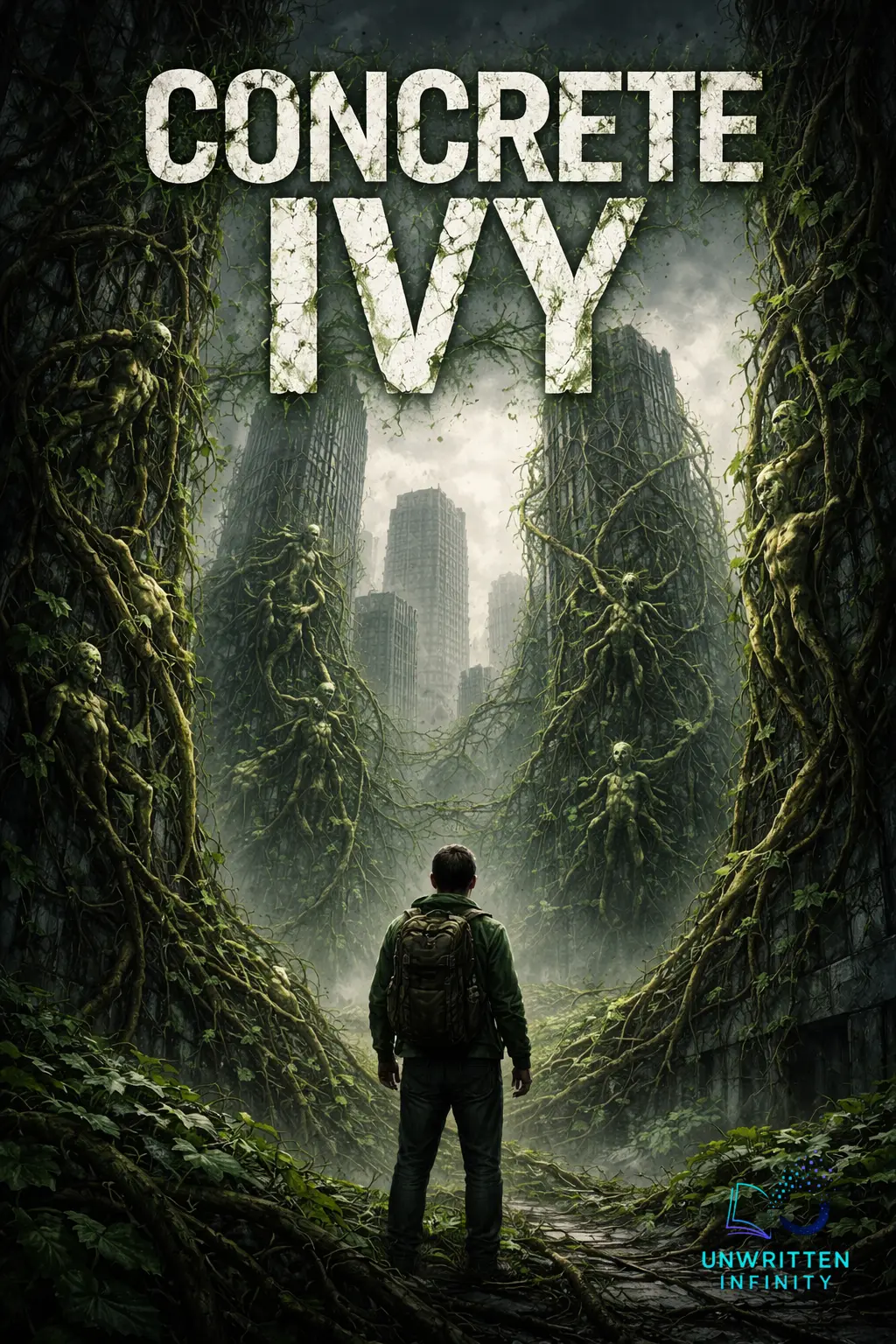
The rain in the city did not smell like water; it smelled like memory and rust. It was a sharp, metallic tang that hit the hot pavement, rising in a hiss of steam that carried the scent of exhaust and old iron. Elias Thorne stood at the edge of the park, his boots sinking slightly into the mud that had replaced the manicured gravel paths. He was a city botanist by trade, a man who usually spent his days cataloging the resilience of dandelions cracking through sidewalk fissures. But today, the dandelions were gone. In their place was a jungle that defied every law of urban ecology he had studied for thirty years.
The park, once a forgotten rectangle of green sandwiched between three monolithic skyscrapers, was breathing.
Elias adjusted his glasses, the lenses fogging instantly in the humid air. He held a clipboard, though he knew the paper would be useless against what lay before him. The ivy wasn’t just climbing the brick walls of the old bandstand; it was weaving itself into the architecture, tightening around the steel beams of the nearby office towers with a deliberate, muscular grip. And the colors were wrong. They were too vibrant, too saturated, pulsing with a bioluminescent rhythm that seemed to sync with the distant hum of the subway trains.
He took a step forward, his boot crunching on a root that felt disturbingly warm. The air was thick, heavy with the scent of ozone and wet earth, but beneath it all, that familiar, acrid taste of city rain lingered on his tongue. It was the taste of the world he knew, the world of concrete and steel, trying to assert its dominance even as it choked.
“Report,” he whispered to himself, his voice sounding thin against the rustling leaves. “Subject: Hedera urbanus. Growth rate: exponential. Anomalous morphological characteristics: humanoid.”
He moved deeper into the park, pushing aside a curtain of ferns that felt like velvet skin. That was the first time he saw it clearly. Near the dry fountain, a cluster of vines had coalesced into a shape that made his stomach turn. It was a woman, or at least, the silhouette of one. Her arms were raised, fingers splayed into delicate, leafy fronds, reaching toward the gray sky. The bark of her form was smooth, pale as bone, and etched with veins that pulsed with a faint, green light.
Elias knew that face. It was Sarah, the barista from the coffee shop two blocks over. She had been missing for three weeks. The police had called it a runaway case, a young woman tired of the grind. But here she was, rooted in the soil, her mouth open in a silent scream that had turned into a flower blooming from her lips.
“I’m sorry,” Elias murmured, reaching out a hand. He stopped inches from her leafy shoulder. The air around her shimmered with heat, distorting the view of the skyscrapers behind her. “I don’t know what you are.”
The vine shifted. Not a random movement of wind, but a deliberate turn. The flower-mouth closed, and the leaves of her hair rustled with a sound like whispering voices. Elias stumbled back, his heart hammering against his ribs. This wasn’t just mimicry. The plants weren’t just shaped like the missing; they were the missing. The earth had taken them, not to kill them, but to repurpose them.
He retreated to the perimeter, his mind racing. The city council had already issued a statement about “unusual fungal growth” and promised a cleanup crew. They didn’t know. They thought it was a pest problem. They didn’t understand that the roots were already digging deep, seeking the bedrock, seeking the foundations of the very buildings that cast shadows over this park.
The next morning, the rain returned. It fell harder this time, drumming against the glass of the observation tower where Elias had set up a temporary lab. He watched the park through the window, the gray water washing over the glass, blurring the lines between the city and the wild. The metallic tang of the rain seeped through the ventilation system, a constant reminder of the environment he was trying to save.
He had spent the night analyzing soil samples. The results were impossible. The soil contained high concentrations of human DNA, fragmented and recombined with plant matter. The cellular structure was a hybrid, a chimera of flora and fauna that shouldn’t exist. But the most terrifying discovery was the root network. It wasn’t just spreading; it was targeting. The thickest, strongest roots were heading straight for the load-bearing pillars of the central skyscraper.
“They’re going to bring it down,” Elias said aloud, the realization cold in his gut. “They’re going to collapse the building.”
He looked at the park again. The humanoid figures were moving now. There were dozens of them. A man made of moss and oak, his legs fused into the ground, standing guard at the park’s entrance. A child made of willow, weeping sap that pooled into the gutters. They were not attacking; they were waiting. They were the guardians of a new territory, a green army rising from the concrete to reclaim the land.
Elias felt a strange pull in his chest. Part of him, the part that had spent decades fighting weeds and preserving the sterile order of the city, wanted to burn it all down. He could call the fire department, bring in the herbicides, the bulldozers. He could save the skyscrapers, the offices, the economy. He could save the city.
But another part of him, a part he had suppressed for years, looked at the park and saw something beautiful. It was a world that had been suffocated for too long, finally breaking free. The missing people, the ones the city had chewed up and spit out, were now the protectors of the earth. Was it vengeance? Or was it justice?
He thought of Sarah, the barista who had worked double shifts until she collapsed. Now she was part of the forest, her pain transformed into something living, something eternal. To destroy the park would be to destroy her again. To save the city would be to commit a second murder.
The rain intensified, turning the streets into rivers. Elias grabbed his gear and headed back down to the park. He needed to see the roots. He needed to know if there was a way to stop them without killing the people trapped inside.
He pushed through the dense undergrowth, the air thick with the smell of wet earth and ozone. The metallic tang of the rain was stronger here, mixing with the sweet, cloying scent of the blooming flowers. It was a sensory overload, a clash of the industrial and the organic.
He reached the base of the central skyscraper. The roots were massive, thick as tree trunks, wrapping around the steel pillars. They were vibrating, humming with a low frequency that he could feel in his bones. The humanoid figures stood in a circle around the building, their faces turned toward the structure. They weren’t attacking; they were holding it.
Elias realized then that the roots weren’t trying to crush the building. They were reinforcing it. The plants were binding the steel and concrete together, creating a living lattice that was stronger than the original structure. They were saving the building from the very thing they were supposed to destroy: the decay of the city.
But the cost was high. The people inside the plants were conscious, aware, and trapped. They were the price of the city’s survival.
Elias fell to his knees, the mud soaking into his trousers. He looked at the face of the man made of oak, a figure he recognized as a homeless veteran who had vanished months ago. The man’s eyes, formed from dark berries, met Elias’s gaze. There was no anger in them, only a profound sadness.
“We are the city now,” the man seemed to say, though no sound came out. “We are the roots that hold you up.”
Elias understood. The city was dying, rotting from the inside out. The concrete was crumbling, the steel was rusting. The plants were the only thing keeping it standing. But to do so, they had to consume the people. They had to turn the victims of the city into its saviors.
He stood up, his decision made. He couldn’t burn it down. He couldn’t save the city by destroying the people who were holding it together. He had to let the green world take its course. He had to accept that the city would change, that it would become something else, something wild and untamed.
He walked back to the edge of the park, the rain washing the dirt from his face. The metallic tang of the city rain hit the hot pavement one last time, a final reminder of the world that was fading away. He looked at the skyline, the skyscrapers now draped in vines, glowing with a soft, green light. The city was still there, but it was no longer the city he knew. It was a garden, a graveyard, a sanctuary.
Elias took a deep breath, filling his lungs with the scent of rain and earth. He was a botanist, and he had finally found the most important species to study. He would stay, he would watch, and he would learn.
The city would survive, but it would never be the same. Nature had taken its vengeance, not by destroying humanity, but by forcing it to evolve, to merge, to become part of the earth it had tried to conquer.
As the sun began to rise, casting a pale light over the green-tinted skyline, Elias whispered the words that would define his new life, the truth that hung heavy in the air between the concrete and the ivy: “Nature’s vengeance is not destruction, but the only path to human survival.”